
Update: October 2011 with the lovely OXIS data.
This page is motivated by two things:
- The need to lock down the background figures that I am using for my thesis
- The fact that every time I do a presentation I end up looking this stuff up – so I want it in one place
I also feel that I should issue a big disclaimer as I am not a statistician and really can’t comment in detail on the robustness of these stats – however as I am concentrating on very reliable sources we should be in safe hands (fingers crossed). I am also not saying that these are the only answers to my statements – I just like these ones…..
What am I interested in?
Before I get into quoting numbers and throwing in the odd chart or two I need to explain what data I am actually after. My facts really fall into three broad areas:
- Who’s online? And by implication who’s not?
- What are they doing there?
- Exactly how democratic are they online and elsewhere?
I also want to find some facts around take up and usage of smart phones and am sure I will find some other random facts on the way…..
Across all these questions I am looking for broad statistical sets that can provide context for the smaller research sample I will get from my field work and ideally I need them to be regular studies so that I can look at the longitudinal effects. This really means I am looking in few main places at present:
Who’s online? And by implication who’s not?
There are a few sources here;
- The Office for National Statistics bulletins
- The OFCOM Communications Fact Sheets
- There is an excellent CLG report on the social impacts of digitial exclusion here – but it is using 2008 figures
- Its also worth looking at this Guardian Article where Martha Lane Fox lays out the data around digital exclusion which has driven much of her Race Online work:
What are they doing there?
The best source of data for the is the Oxford Internet Institute study (OXIS)- our answer to the marvellous Pew Reports – though the specific OFCOM Communications report on Internet use is also very helpful. The OXIS is taken every 2 years and I have now updated this page to include the 2011 data.
Exactly how democratic are they online and elsewhere?
For democratic behaviours I am looking at the Citizenship Study from the CLG as well as these two reports from the Hansard Society:
And now the shiny new Networked Neighbourhoods Study as well which I wrote about in more detail here.
Smart phones because they are SO 2011…..and indicate Next Generation Users
In terms of the smart phone stuff its probably back to OFCOM with their communications market reports which holds such lovely facts as:
- Data volumes over mobile networks increased by 240 per cent in 2009.
- Over a quarter of people in the UK (26.5 per cent) said they have a smartphone, more than double the number two years ago.
- Nearly a quarter of adults (23 per cent) accessed content or sent emails on their mobile phones. Among 15-24s this rises to 45 per cent.
- UK consumers who have internet-enabled phones are also spending almost as much time surfing the net on their mobiles (1.3 hours per month) as they do texting (1.5 hours per month).
- Facebook accounted for almost half (45 per cent) of total time spent online on mobiles in December 2009
All of this looking like strong evidence for the claim that the smart phone is in many ways changing the way in which we use the Internet. Interesting the UK are more likely to use a portable device (includes netbooks) to use the internet than a fixed PC. However some caution – we are really talking about 20% using social networking sites predominantly on mobile devices in the highest demographic (16-24) for this behaviour. However the breakdown of the behaviour is interesting:

In the course of all this I have also read the Digital Britain report from 2009 – and yes it really is a corker. Have not finished it yet so will add this later….
HOWEVER…..The big issue with these statistics is however the pace of change – I will more than likely revisit this all before I hand the final thing in (ha – hand it in! Finish it??!!! Slight hysterical pause from author followed by deep breath…it will be this year…really..it will…sorry about that…moving on). Anyway – for example the digital exclusion data from 2008 is excellent but how is it effected by smart phone take-up which is hugely increasing (See OFCOM Communication Market Report)? And for that matter how is the Hansard Audit of engagement affected?
The OXIS report is fairly clear that smartphones and tablets are important and in fact indicate next generation internet use. They define a next generation user as:
someone who accesses the internet from multiple locations and devices. Specifically, we operationally define the next generation user as someone who uses at least two internet applications (out of four applications queried) on their mobile or who fits two or more of the following criteria: they own a tablet, own a reader, own three or more computers. By this definition 44.4% of internet users in Britain were next generation users
These next generation users are significant in that they dominate in the areas that we associate with the social web – content creation, social networking and also with respect to levels of trust and even political efficacy. They are also have higher levels of income and are more likely to be employed so this is not a representative group
But now on to Facts facts facts…..
I’m going to organise this in terms of statements that I am making or questions that I am raising in the course of research or presentations and then a suggestion as to some supporting facts. Feel free to quarrel at the end. Some of these statements are fairly obvious – they just need substantiating if you are being thorough.
Internet use is growing within the UK
Below are the current stats from OFCOM on Internet Use.

These are all growth figures over the last few years as you will see from the next chart.
Social networking is the fastest area of growth in terms of internet take up
OFCOM show social networking as being the fastest growth area for internet users (OFCOM 2010)

OXIS and OFCOM both agree that individual and household access are basically the same and that most internet connections are now broadband. The digital divide question is now between the non-users, first generation and second generation users.
Content creation as a whole is on the increase with OXIS 2011 putting this as something that 25% of the online population are doing. This includes using social networking sites:
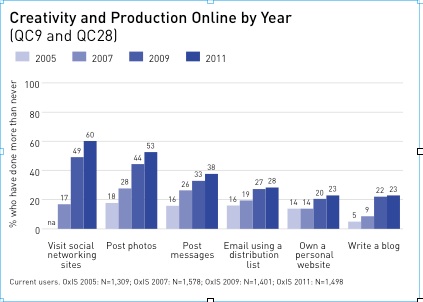
If we look at the next generation users then you can see how they behave differently:

These trends can be demonstrated across different demographic groups
And though use of social networking is dominated by 15-34 year olds there is growth is steady growth in all demographic groups – including over 75s! OFCOM 2010

Breakdown in terms of sites and behaviours (OFCOM 2010):

The differential between Facebook and anything else is always worth remembering. But its also worth noting the following changes:
- LinkedIn’s user base grew 96%
- Twitter’s rose by 56% (although this does not include traffic from third-party applications). Growth on both of these sites was from a much lower base than that of Facebook.
- MySpace and Bebo both experienced annual declines of 37% and 60% respectively in their unique audiences.
- Friends Reunited, saw its audience fall by 39%.
But for those of us who are interested in showing the grip that social media has on the internet population you need to look at the proportion of online time being taken up with it:
Perhaps an even more significant indicator of the growth of social networking is the increase in the proportion of total internet time that it accounts for. Figure 4.4 shows that in April 2007 social networking and blogs accounted for 9% of UK users’ total internet time, according to audience data from UKOM/Nielsen. By April 2010, this had risen to 23%. This figure is broadly comparable to our consumer’s digital day research (see Section 1.3), which put the proportion of total online computer time spent using social networking sites at 18%. The small difference between these two figures is likely to relate to methodological differences between consumer research and audience analysis (OFCOM 2010)
Digital exclusion – not to be forgotten
I think need to balance all of this good news with some more grounding facts about digital exclusion…..One of the key findings from the CLG report was the lack of a link between social and digital exclusion. However “it seems that offline social isolation makes engagement with the social aspects of the Internet very unlikely. Similarly, economic disadvantage makes engagement with the financial and government services offered through the Internet very unlikely. In summary, individuals with specific disadvantages appear to be excluded from the very applications of technology that could help them most.
In order to support this conclusion the report mapped this in terms of expected and unexpected exclusion:

This same report shows a typology of 11 types of internet engagement and puts Civic activities at the highest level of this (they break them in 3 stages):

And here are some more quotable but slightly less robust figures from the Guardian Article – I am sure they are good but need cross checking with other sources:
- Ten million of us in the UK have never used the internet.
- Four million of those who are offline are society’s most disadvantaged: 39% are over 65.38% are unemployed – 19% are adults in families with children.
- 40m adults in the UK use the web, and 30 million of us do so daily.
- Worldwide, we send 55m tweets via Twitter a day. In the UK alone, 25m of us are on Facebook. 16m people watch TV or listen to the radio via the web. Millions of us now use sites like Meetup.com to get together offline in our local communities.
- 3.1m over-65s go more than a week without seeing a friend, family or neighbour and half of all internet users say the web increases contact with friends who live further away. Yet 6.4m over-65s have never used the internet, with 63% of them saying they ‘see no reason’ to get online.
The OXIS 2011 survey actually shows fairly apathetic levels of political engagement and though being online generally indicates higher levels of political efficacy and also participation the levels achieved are really not particularly cheering for anyone interested in political participation. Though use of government services and participation continues to rise we are not seeing an upswell of activity here – not even a spike from the 2010 election.
This can be contrasted with data from the citizenship survey (April 2010) which also talks about participation more generally:
- Thirty-one per cent of adults in England engaged in civic participation at least once in the 12 months prior to interview; fewer than in any previous year of the survey.
- 38 per cent of people felt they could influence decisions in their local area; levels are unchanged on all previous years apart from 2001 when it was higher (at 44 per cent).
- Although unchanged since 2009-10, there have been reductions in the proportion of people feeling that it is important for them to be able to influence decisions (72 per cent in April-June 2010 from 79 per cent in 2007-08 and 78 per cent in 2008-09) and the number of people who would like to be more involved in local decision making (42 per cent in April-June 2010 from 50 per cent in 2007-08 and 49 per cent in 2008-09).
This figure of 38% of people feeling that they can influence decision-making processes in their area with the figure of 59% from the Networked Neighbourhoods research.
This can be contrasted with the Hansard Annual Audit which talks about national participation as follows:
- Two in five people (41%) have ‘discussed politics or political news with someone else’ in the last two or three years.
- Reflecting the high profile expenses scandal in 2009, by far the most discussed political issue was ‘MPs’ expenses’ with seven in 10 people (71%) saying they have discussed this with family and friends.
- There has been a 4% increase this year in the proportion of the public who report having ‘signed a petition’ (40%) and having ‘attended a political meeting’ (8%).
- One in 11 people (9%) have ‘expressed their political opinions online’. Only a small number of people use either Facebook (4%) or Twitter (2%) to follow a political group or politician.
The OXIS survey doesn’t look at civic participation beyond membership of non-political associations (such as sports clubs) and we I think this is perhaps a difference with respect to the other data sets – but the overall levels of activity look very low with some in fact dropping off since 2009. Overall I am finding the definitions in the OXIS section on politics a little woolly compared to Hansard but this reflects the more general nature of the survey.
For example look at what Hansard figures on what people understand by ‘politics’:
- 26%: the way the country is governed/running the country/what the government does;
- 18%: Parliament;
- 14%: elections/voting
- Group 1: Politically committed (10% of British adults)
- Group 2: Active campaigners (14% of British adults)
- Group 3: Interested bystanders (14% of British adults)
- Group 4: Detached cynics (17% of British adults)
- Group 5: Politically contented (6% of British adults)
- Group 6: Bored/apathetic (8% of British adults)
- Group 7: Disengaged/mistrustful (24% of British adults)
- Group 8: Alienated/hostile (9% of British adults)
Returning to the Hansard Audit Page 51 onwards shows some of the activities which typify these groups and I will be cross referencing the detail with my own categorisation types. The chart below shows these groups’ voting behaviours in national/local breakdown:

Would also like to note that at 40% signing a petition is by far the most popular political activity.
One of the most detailed source of data from my point of view is the Hansard Society’s Digital citizens and democratic engagement report with headline facts as follows:
- 70% of respondents agree that the internet makes it easier for them to participate in civic and political activities
- 49% agree that they would generally prefer to use the internet to participate in civic and political activities
- Age is not a barrier to digital engagement when it comes to contacting one’s elected representative
- People aged 55-64 are the age group most likely to contact their MP online (54% did so), and people aged 18-34 were more likely to use the telephone (including mobiles and texting) than any other age group
This is a relatively small sample (2003) but broadly representative demographically. The big draw back is that the sample was 100% internet users which means that we have to remember that this is not going to speak for the digitally excluded. However this is not a major issue given the Digital Exclusion report finding that there is no strict pattern to digital exclusion which means that we can take these results as acceptably robust for the population. Al that being said participation numbers are high when compared to the larger Hansard study:
- Voted in an election 78%
- Signed a petition 76%
- Donated money to a campaigning organisation 37%
- Took part in a protest or demonstration 15%
- Joined a campaigning organisation 14%
- Joined a political party 11%
- Donated money to a political party 9%
Overall it supports the conclusion that the internet is a Good Thing when talking about civic and political participation.
PHEW
That’s all for now folks – though I may add to this section which is why I’ve created it as a page rather than a post. If you have questions you would like to add or answers you think I’ve missed – or indeed more FACTS – then please shout – your help would be very welcome.